Carnatic music is Krithi or Song based. Ie., Krithis or Songs composed by Vaggeyakaras [Composers] occupy an important position in a Carnatic Music Concert. It is hard to listen to Concert without Kritis or Songs. Technically these songs are called Kritis or Keerthanas or Viruththams. Sometimes Viruthams or Slokas are rendered prior to a Song.
Therefore it will be interesting to make a study on ‘Songs-Section’ of the Music Concert.
From the Concert point of view, whether it is a Vocal Concert or Instrument rendering, the selection of songs is generally the choice of the main artist. The organizers or Sabhas will keep away from the Song selection process for the concerts, though the Concert may be on a particular theme. The artists will chose the songs keeping the theme in mind. And of course, the Sampradhaya or tradition will be respected by the Artists while choosing the Songs.
The first Musical piece in a concert will normally be a Varnam or a krithi on Lord Ganesha. Sometimes the artist may choose to sing a slokam as invocatory Song.If the Song is on Lord Ganesha, it may be in the Ragas Nattai, Gowlai, Hamsadwani, Sriranjani, Ataana, Gambira Nattai etc. The artist chooses the first song to impart, what is called “ Melakozuppu”[Musical atmospher] in a brisk tempo. Raga Alapanai for these song will be short and crisp and sometime the artist may start the first song straight away.
The subsequent songs will be chosen by the artist based on the Theme or occasion. The initial few krithis will be for shorter duration and there will be longer pieces at the middle of the Concert. At the end of one of the longer pieces there will be“ Thani Aavarthanam” by the percussion Artists.
Main Krithis are those in Ragas providing ample scope for elaborate Aalapana, Thanam, Niraval, Swarakalpana and takes longer time to render. Artist will have opportunity to show their caliber in Manadarma in these Musical pieces which is the strength in Carnatic Music.
Thukkadas are those songs, rendered at the end of the Concert, which are lighter in nature including Folk Songs Bhajans etc.
Finally, the Concert are concluded with a Mangalam , normally in one of the Ragas Madyamavathy , Sri Ragam , Suruti,, Sowrashtram Punnagavarali etc
Saturday, July 12, 2008

Saturday, June 14, 2008
Concert
Going to a Music concert is one of the joyful moments for music lovers.For an individual, the significance in attending a concert anchors on many factors like his favorite artist, venue of the concert, theme, occasion and so on.It is a fact that attending a live concert in an auditorium or other music venue has got many interesting and educative points for appreciation.
Many music Rasikas who want to appreciate music in a real sense, attend the concert with open mind , whoever be the artist or accompaniment. Of course, they will collect all information about artists beforehand. This will give him a variety of musical input he is thriving for. The main advantage of attending live Musical concert is that the audience can witness the artists in their full capacity who show their talent in manaodarma which is the vital factor, as there is no time restriction in rendering musical pieces.
Since the main aim for a Rasika is to appreciate Music, he will arrive at the venue in advance and occupy seat in such a way that he can see all the artists clearly.
It is interesting to enjoy the artists way of communication among themselves during the concert by their body language and gestures.
Some of the areas in which a Carnatic Music Concert can be enjoyed and appreciated are:
* Song Selection- whether it is thematic or the way it matches with occasion.
* Major Ragam handled for extensive Raga Alapanai and Swara Prasthara.
* Seating arrangements of the artists on the stage.
* Language of the songs selected.
* Whether the songs are popular or Apoorva and their composers.
* Whether the Ragas are popular or Apoorva
* The first song, Major Raga and song to which Thani Avarthana takes place, end pieces or Thukkadas , the last song.
* Number of songs.
* The Guru of the artists.
* Clarity of pronunciation.
* Attire of the artists.
* Stage lighting and sound arrangements.
* Time of the day of the concert.
* Going through review in news papers and periodicals.
Wednesday, May 28, 2008
Concert Platform
Normally, all Music Concerts are held on a stage which is raised a little bit above the floor level. There will be enough space to accommodate the main artist and the accompanying artists.If it is a vocal Carnatic Concert, the main artist occupies the middle position and Violin and Mrudangam artists occupies the position of either side of the main artist facing each other. Violin and Mrudangam artists occupy either left or right side of the main artist depending on whether the Mrudangam artist is left handed or right handed.
Thambura artist occupies the position just behind the main artist. Some singer prefers to have two Thamburas. In this case the Thambura players will be sitting behind the main artist on either side.This is the general seating arrangement of the artists on the stage for a Carnatic Music Concert.
There are concerts where many more accompaniments such as Ghadam, Kanjeera, Konnakol,Morsing etc. ,accompany the main Vocal artist.These artists occupy the position behind the main artist.Konnakol is an art of performing the percussion syllables vocally in the concert.
Some Vocal artists prefer to have another vocalist- preferably his student- for Vocal support. The supporting artist sings only the songs along with the main artist and may not participate in Manodarma portion of the concert.
If the main artist is a Violin player, then the Mrudangam player occupies left or right side and other accompaniments as described above.Normally, there will be no violin accompaniment in Violin concert. There are concerts where there will be two or three main Violin artists.
For Veena and Flute concert there will be Mrudangam and/or Gadam and/ or Kanjeera and/or Morsing accompaniments.
For Nadaswaram concert, Thavil, the percussion instrument, is the accompaniment and there may be two Thavils in some concerts, the artists sitting on either side of the main artist(s) facing each other. The Sruthi or Drone instrument is the "Oththu " which is similar to Nadaswaram but a little smaller in size.The artist playing this instrument sits behind the main artist(s). Sruthi will be provided by this Artist throughout the concert.The Talam is maintained by the artist playing a specially made Cymbal , sitting behind the main artist(s). This artist plays the Cymbal producing continuous ringing tone for the beat and damped tone for the wave of the Talam. There will be no tone for the finger counts.
The above descriptions are normally seen in Carnatic music concert stage adhering to tradition or Sampradaya and of course, there are exemptions and deviations.
In the group singing or fusion music concerts or in Carnatic music orchestras, the seating arrangements are decided by the group leader.
Thambura artist occupies the position just behind the main artist. Some singer prefers to have two Thamburas. In this case the Thambura players will be sitting behind the main artist on either side.This is the general seating arrangement of the artists on the stage for a Carnatic Music Concert.
There are concerts where many more accompaniments such as Ghadam, Kanjeera, Konnakol,Morsing etc. ,accompany the main Vocal artist.These artists occupy the position behind the main artist.Konnakol is an art of performing the percussion syllables vocally in the concert.
Some Vocal artists prefer to have another vocalist- preferably his student- for Vocal support. The supporting artist sings only the songs along with the main artist and may not participate in Manodarma portion of the concert.
If the main artist is a Violin player, then the Mrudangam player occupies left or right side and other accompaniments as described above.Normally, there will be no violin accompaniment in Violin concert. There are concerts where there will be two or three main Violin artists.
For Veena and Flute concert there will be Mrudangam and/or Gadam and/ or Kanjeera and/or Morsing accompaniments.
For Nadaswaram concert, Thavil, the percussion instrument, is the accompaniment and there may be two Thavils in some concerts, the artists sitting on either side of the main artist(s) facing each other. The Sruthi or Drone instrument is the "Oththu " which is similar to Nadaswaram but a little smaller in size.The artist playing this instrument sits behind the main artist(s). Sruthi will be provided by this Artist throughout the concert.The Talam is maintained by the artist playing a specially made Cymbal , sitting behind the main artist(s). This artist plays the Cymbal producing continuous ringing tone for the beat and damped tone for the wave of the Talam. There will be no tone for the finger counts.
The above descriptions are normally seen in Carnatic music concert stage adhering to tradition or Sampradaya and of course, there are exemptions and deviations.
In the group singing or fusion music concerts or in Carnatic music orchestras, the seating arrangements are decided by the group leader.
Friday, May 23, 2008
Language
Music is considered a language by itself and is of emotions and feelings. Moreover, it is universal too. This is the reason , we are able to enjoy music of any country.
Music has got no geographic boundary nor color or creed. Music composed specifically for instruments have no language and is equqlly enjoyable.
Of course, the songs are composed in many languages to convey messages, feelings and emotions. The lyrics sung with appropriate Ragam enhances the beauty of the Music as a whole.
In Carnatic Music, Alapana and Thanam has no language in it. The syllables used have no meaning, such as, “tThe a, da, ri, nam, thom” for Raga Alapana and “anamtha, taanamtha, tananna, tanamna etc”., for Thanam singing. Raga Alapana and Thanam are played or sung with the above syllables for song of any language .
singing or playing of Raga Alapana or Thanam,for songs is entirely the chose of the artist.
Music has got no geographic boundary nor color or creed. Music composed specifically for instruments have no language and is equqlly enjoyable.
Of course, the songs are composed in many languages to convey messages, feelings and emotions. The lyrics sung with appropriate Ragam enhances the beauty of the Music as a whole.
In Carnatic Music, Alapana and Thanam has no language in it. The syllables used have no meaning, such as, “tThe a, da, ri, nam, thom” for Raga Alapana and “anamtha, taanamtha, tananna, tanamna etc”., for Thanam singing. Raga Alapana and Thanam are played or sung with the above syllables for song of any language .
singing or playing of Raga Alapana or Thanam,for songs is entirely the chose of the artist.
Monday, May 12, 2008
Talam
Talam is one of the important topics in Carnatic Music and can be explained in a simple way so that the Rasikas can understand and Appreciate.
We all know the meaning of Rhythm which can be explained as the repetition of elements with an equal time interval. The word “ Time” is used here since we deal with Music in which time measure is playing an important roll.
Rhythm is explained below in a simple manner . Each number shown below represent a beat or Count[which is called an Akshara ] and the distance between them indicates the time interval. Shorter or longer interval shows the “Tempo”.
1…2…3…4…5…6…7…8…9…10…11…12…13…14…15…16…17… and so on.
This can go on for any length of time.
The Rhythm may follow a pattern as shown below,
1…2…3…4…5…6…7…8…1…2…3…4…5…6…7…8…1…2…3…4…5…6…7…8…and so on.,
We may explain that Rhythm follows a pattern of 8 and this cycle is repeated and can be called a Rhythmic pattern.
This type of counts following a Rhythmic pattern may be called as Talam. The number of counts will vary with each variety of Talam. The cyclic counts of 8 is called Adi Thalam, 6 is called Rupaka Talam etc., One complete such cycle is called one Aavartham.
There are a total of 35 Tala Variety in Carnatic Music. The total number of counts per cycle may range from 3 to 29.[Further advance study on Tala we understand, that there are over 175 Talas and is not dealt here due to their complexity.]
The Rasikas might have noticed in the concert that the Vocal artist perform Tala by gently beating the Right hand palm on the Right Thigh ,counting the fingers and waving the Palm. There are various sequences of these actions according to the Tala variety.
The finger counts will follow the sequence of a beat, little finger,ring finger, middle finger, beat, Wave,beat,and wave.
The action or kriya- a beat and finger counts is called Laghu, a beat and wave is called Drutham and beat alone is called Anudrutham.
The following photographs show the action or Kriya of Adi Talam.
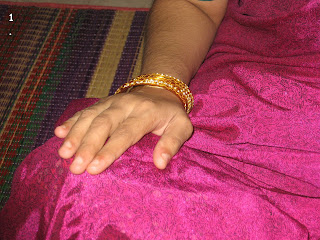
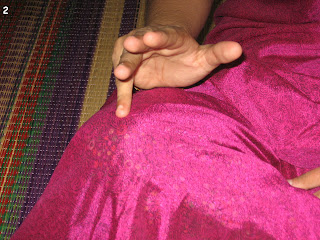
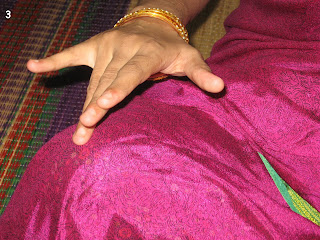
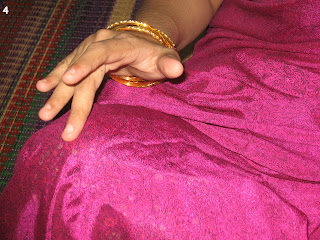
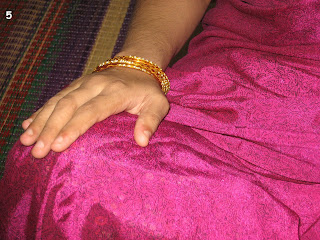
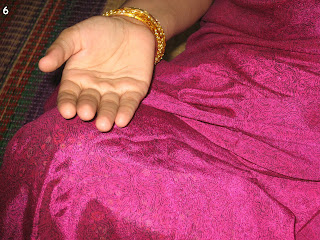
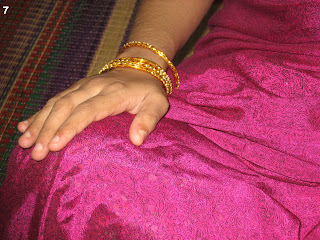
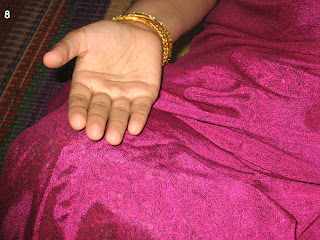
The artist playing instruments may seek the help of others to perform Tala sitting in front of the Artist amongst audiences or may be able to play without help from outside correctly by virtue of their experience.
The artist playing cymbals helps the main artist to maintain Talam in Nadaswaram concerts.
The time span of one cycle of a Talam will normally match with a lyric- sentence. This is the reason for the various varieties of Talam.
Here are a few examples to explain the above statement taken from the kritis of Sri Muthuswamy Dikshithar:
Lyrics for………………………..............Ragam………..Talam……Counts.
one Aavartham
1. Sooryamurthe Namosthuthe.. Sowrashtram……Druva Talam …14
2. Chandram Bhaja Manasa……....Asavery………….Matya Talam....10
3. Angaaraka……………………….......Surati…………….Rupaka Talam...6
4. Budamaasrayami Satha………Natakuranji…….Jampa Talam………10
5. Bruhaspathe Tharaa Pathe…..Ataana…………..Triputa Talam..….7
6. Sri Sukra Bhagavantham………Paras…………….Ata Thalam…………14
7 Dhivaakara Thanu……………….Yadukula Kambo…Eka Talam…....4
Note: The number of counts given at the last column is taken from basic Sapthatalas and their subdivisions are not taken into consideration.
The Rasikas should note that there is no Talam for Raga Alapana, Thanam, Virutham singing, slokas etc.
Moreover there is no rule that various Krithis in a particular Raga must be in one Tala. [That is to say, various Kritis in a Raga may be in different Tala]. But a specific kriti has been composed in a particular Tala.
We all know the meaning of Rhythm which can be explained as the repetition of elements with an equal time interval. The word “ Time” is used here since we deal with Music in which time measure is playing an important roll.
Rhythm is explained below in a simple manner . Each number shown below represent a beat or Count[which is called an Akshara ] and the distance between them indicates the time interval. Shorter or longer interval shows the “Tempo”.
1…2…3…4…5…6…7…8…9…10…11…12…13…14…15…16…17… and so on.
This can go on for any length of time.
The Rhythm may follow a pattern as shown below,
1…2…3…4…5…6…7…8…1…2…3…4…5…6…7…8…1…2…3…4…5…6…7…8…and so on.,
We may explain that Rhythm follows a pattern of 8 and this cycle is repeated and can be called a Rhythmic pattern.
This type of counts following a Rhythmic pattern may be called as Talam. The number of counts will vary with each variety of Talam. The cyclic counts of 8 is called Adi Thalam, 6 is called Rupaka Talam etc., One complete such cycle is called one Aavartham.
There are a total of 35 Tala Variety in Carnatic Music. The total number of counts per cycle may range from 3 to 29.[Further advance study on Tala we understand, that there are over 175 Talas and is not dealt here due to their complexity.]
The Rasikas might have noticed in the concert that the Vocal artist perform Tala by gently beating the Right hand palm on the Right Thigh ,counting the fingers and waving the Palm. There are various sequences of these actions according to the Tala variety.
The finger counts will follow the sequence of a beat, little finger,ring finger, middle finger, beat, Wave,beat,and wave.
The action or kriya- a beat and finger counts is called Laghu, a beat and wave is called Drutham and beat alone is called Anudrutham.
The following photographs show the action or Kriya of Adi Talam.


The artist playing instruments may seek the help of others to perform Tala sitting in front of the Artist amongst audiences or may be able to play without help from outside correctly by virtue of their experience.
The artist playing cymbals helps the main artist to maintain Talam in Nadaswaram concerts.
The time span of one cycle of a Talam will normally match with a lyric- sentence. This is the reason for the various varieties of Talam.
Here are a few examples to explain the above statement taken from the kritis of Sri Muthuswamy Dikshithar:
Lyrics for………………………..............Ragam………..Talam……Counts.
one Aavartham
1. Sooryamurthe Namosthuthe.. Sowrashtram……Druva Talam …14
2. Chandram Bhaja Manasa……....Asavery………….Matya Talam....10
3. Angaaraka……………………….......Surati…………….Rupaka Talam...6
4. Budamaasrayami Satha………Natakuranji…….Jampa Talam………10
5. Bruhaspathe Tharaa Pathe…..Ataana…………..Triputa Talam..….7
6. Sri Sukra Bhagavantham………Paras…………….Ata Thalam…………14
7 Dhivaakara Thanu……………….Yadukula Kambo…Eka Talam…....4
Note: The number of counts given at the last column is taken from basic Sapthatalas and their subdivisions are not taken into consideration.
The Rasikas should note that there is no Talam for Raga Alapana, Thanam, Virutham singing, slokas etc.
Moreover there is no rule that various Krithis in a particular Raga must be in one Tala. [That is to say, various Kritis in a Raga may be in different Tala]. But a specific kriti has been composed in a particular Tala.
Subscribe to:
Posts (Atom)